
Quick Summary
- Chinch bug damage in St. Augustine grass often looks identical to drought stress — making early misdiagnosis the #1 reason small infestations become lawn-destroying ones.
- The Southern Chinch Bug injects a phytotoxic enzyme directly into your grass stolons, killing turf from the inside out — and no amount of extra watering will fix it.
- Repeated use of store-bought insecticides is creating genetically resistant chinch bug populations across Southwest Florida, making professional IPM strategies the most effective long-term solution.
Those Brown Patches Aren’t Asking for More Water — They’re a Warning Sign
You’ve been watering on schedule. You’ve kept up with fertilizing. But sometime between March and May, a yellow patch showed up near the edge of your lawn — and now it’s spreading.
Before you drag out the hose again, stop. That expanding ring of dead turf isn’t thirsty. There’s a very good chance it’s being eaten alive.
Southern Chinch Bugs are the most destructive lawn pest in Southwest Florida, and they’ve mastered one cruel trick: their damage looks almost identical to drought stress. That confusion costs Cape Coral homeowners hundreds —sometimes thousands— of dollars every dry season.
Here’s what’s actually happening, and how to stop it before it reaches the point of no return.
Why Chinch Bug Damage Looks Like Your Lawn Is Just Thirsty
When a chinch bug feeds on St. Augustine grass, it doesn’t chew — it stabs. Its piercing-sucking mouthparts puncture the stolon (the horizontal stem that holds your lawn together) and inject a phytotoxic enzyme directly into the plant’s vascular tissue.
Think of it like a tiny syringe of weed killer delivered from the inside. That enzyme disrupts the grass’s ability to transport water and nutrients, causing rapid, irreversible cellular death. The grass doesn’t wilt — it dies. And because the damage starts at the soil level, by the time you see yellow and brown above ground, the destruction below is already well underway.
The result? A lawn that looks like it needs water but can’t absorb it, no matter how much you give it.
This is why so many Southwest Florida homeowners overwater in response, which only adds insult to injury by creating the humid, thatch-heavy microclimate that chinch bugs love most.
How to Confirm You’re Dealing With Chinch Bugs (Not Drought or Fungus)
There are three common culprits behind brown patches in SWFL St. Augustine lawns: drought stress, brown patch fungus, and chinch bugs. Here’s how to tell them apart quickly.
The visual clue: Chinch bug damage typically starts in the sunniest, most heat-stressed areas of your lawn — near driveways, curbs, or open areas with full sun exposure. It expands outward in an irregular “halo” pattern, with yellowing grass on the outer edge and dead brown turf at the center.
Drought stress, by contrast, tends to affect the whole lawn more evenly. Brown patch fungus usually appears in circular rings and is more common during cooler, wet weather.
The coffee can test: If you’re not sure, here’s a simple confirmation method. Cut both ends off a large metal coffee can, push it a few inches into the soil at the edge of a damaged area, and fill it with water. Wait 5 minutes. If you see small, fast-moving insects floating to the surface, you have chinch bugs.
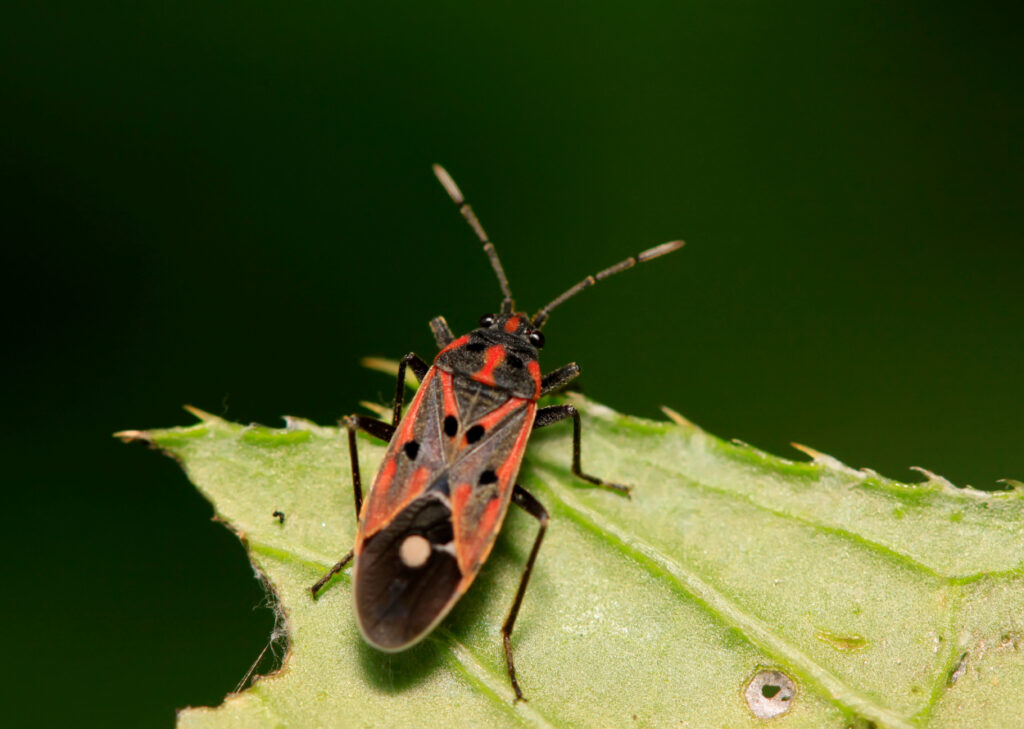
Adult chinch bugs are about the size of a pencil eraser: black with distinctive white wings folded across their backs. The nymphs are tiny, bright orange, and far more destructive because they’re actively feeding.
The Thatch Layer: Why Your Lawn Is Giving Them the Perfect Home
Here’s something most homeowners don’t realize: chinch bugs don’t live on top of your grass. They live inside the thatch layer — that dense, spongy mat of dead organic material that accumulates between the soil and the green blades above.
Thatch above half an inch thick acts like an insulated apartment building for chinch bugs. It protects their eggs from heat, hides nymphs from predators, and blocks most surface-applied sprays from ever reaching them.
This is why thatch management is one of the most powerful prevention tools you have. Core aeration and regular dethatching — tailored to Lee County’s sandy soils — reduces the habitat that allows populations to explode.
Why Your Store-Bought Spray Is Making This Worse
This is the part most homeowners never hear — and it’s the most important thing in this article.
Over the past two decades, the repeated use of broad-spectrum, off-the-shelf insecticides has created something alarming in Southwest Florida: genetically resistant chinch bug populations.
Here’s how it works. When you spray a general-purpose insecticide, you kill most of the bugs — but not all of them. The survivors are, by definition, the ones with a natural genetic tolerance for that chemical. They reproduce. Their offspring inherit that resistance. After a few generations, you have a local population that your spray barely affects at all.
It’s the same biological principle behind antibiotic resistance in bacteria. The more you rely on a single broad-spectrum solution, the faster you breed a population that laughs at it.
In Cape Coral and the surrounding Lee County communities, we’re seeing this play out in real time. Homeowners spray, get temporary relief, and then watch the infestation return stronger than before — often within the same season.
The answer isn’t a stronger chemical. It’s a smarter strategy.
What Actually Works: IPM and Targeted Treatment
Integrated Pest Management (IPM) is the approach we’ve relied on for over 30 years at Maximum Pest Control — and it works precisely because it doesn’t treat your lawn like a chemistry experiment.
IPM targets the pest’s reproductive cycle at the nymph stage, when chinch bugs are most vulnerable and before they develop resistance mechanisms. It also preserves the beneficial predatory insects — like big-eyed bugs and minute pirate bugs — that naturally keep chinch bug populations in check. Broad-spectrum sprays kill these allies indiscriminately, removing one of your lawn’s best natural defenses.
Our treatments use EPA-approved, pet-safe products applied at the right concentration, at the right time, in the right locations — not blanket-sprayed across the whole yard. The goal is to break the lifecycle, not just knock down the visible population.
A Proactive Prevention Plan for SWFL Homeowners
You don’t have to wait for an infestation to act. These cultural practices dramatically reduce your lawn’s vulnerability during the dry season:
- Mow at 2.5–3 inches. St. Augustine grass cut too short is stressed grass, and stressed grass is a magnet for chinch bugs. Keep your mowing height in the right range to maintain a healthier, more resilient turf.
- Water deeply, not frequently. Shallow, frequent watering encourages the thatch buildup that chinch bugs thrive in. Water 2–3 times per week to a depth of 6 inches, and let the soil dry slightly between cycles.
- Dethatch and aerate annually. Especially in Lee County’s sandy soils, annual aeration improves drainage and removes the protective thatch layer that shelters nymph populations.
- Go easy on high-nitrogen fertilizers. Over-fertilizing with synthetic, nitrogen-heavy products creates lush, soft growth that chinch bugs actively prefer. Use slow-release, balanced fertilizers instead.
- Inspect the perimeter monthly during the dry season. Walk the sunny edges of your lawn — near driveways, sidewalks, and curb lines — in March through June. Early detection is everything.
Can a Damaged Lawn Recover?
It depends on how far the damage has progressed. If caught early — at the yellowing stage, before the stolons are fully destroyed — St. Augustine grass can recover with proper treatment and cultural care. The living stolons surrounding the damaged area will eventually fill back in.
Severe damage, where large sections of turf are completely dead, and the stolons are gone, typically requires resodding. This is why early action matters so much. A $200 treatment in April is a far better outcome than a $2,000 resodding job in July.
Conclusion & Next Steps
Chinch bugs are a fact of life in Southwest Florida. But a destroyed lawn doesn’t have to be.
The key is knowing what you’re actually looking at, understanding why DIY solutions often backfire, and having a prevention plan that works with your lawn’s biology — not against it.
If you’re already seeing the early signs of damage, or you want to get ahead of the dry season before it starts, we’re here to help. Every service starts with a thorough inspection, and we’ll build a customized treatment plan based on your property’s specific conditions — safe for your family, your pets, and the environment.
Schedule a free inspection with Maximum Pest Control → Our team has been protecting Cape Coral and Lee County lawns for over 30 years, and we’re committed to getting the job done right — the first time.
Frequently Asked Questions
Why does early chinch bug damage in St. Augustine grass look so similar to a lawn that just needs more water?
Chinch bugs inject a phytotoxic enzyme into the grass stolon that disrupts the plant’s ability to transport water internally. The grass appears drought-stressed because it literally cannot move moisture through its vascular tissue — even when soil moisture is adequate. This makes overwatering one of the most common (and costly) misdiagnoses in Southwest Florida lawns.
Why do DIY insecticide sprays often fail to penetrate the thatch layer where chinch bugs live and breed?
Chinch bugs spend most of their lifecycle — including the egg and nymph stages — inside the thatch layer, which can be half an inch or more thick in poorly maintained St. Augustine lawns. Most store-bought sprays are applied as surface treatments and don’t penetrate deeply enough to reach active populations. Compounding the problem, years of repeated broad-spectrum chemical use in SWFL have produced locally resistant chinch bug populations that are less affected by these products even when contact is made.
What makes the Floratam variety of St. Augustine grass increasingly vulnerable to chinch bugs after years of natural resistance?
Floratam was originally developed with a natural resistance to the Southern Chinch Bug, but that resistance has eroded significantly over time. As chinch bug populations have evolved — partly driven by the selection pressure of widespread insecticide use — they’ve developed the ability to overcome Floratam’s biochemical defenses. Today, Floratam should not be treated as a resistant cultivar in Southwest Florida; it requires the same proactive monitoring and IPM-based management as any other St. Augustine variety.
 Why Cape Coral’s Coastal Humidity Demands a Different Kind of Pest Prevention