
Quick Summary
- Modern termite baiting systems eliminate entire colonies without chemicals, evacuation, or disruption to your pets or daily routine.
- Traditional tenting uses sulfuryl fluoride gas — effective, but requires 2–3 days of hotel stays, extensive food prep, and poses real risks to Cape Coral’s fragile groundwater and canal systems.
- For most Cape Coral homeowners dealing with subterranean termites, EPA-approved baiting is the safer, smarter, and comparably effective long-term solution.
You Shouldn’t Have to Choose Between Protecting Your Home and Protecting Your Dog
Here’s the situation most Cape Coral homeowners find themselves in: you spot the signs — mud tubes along the foundation, hollow-sounding wood, maybe a swarm near a window — and you call a pest control company. They say the word “tenting,” and suddenly you’re mentally calculating how to board the dog, where to stay for three nights, what food needs to be bagged, and whether your prize bougainvillea is going to survive having a fumigation tent draped over it.
It’s a lot. And the good news is, for most termite infestations in Southwest Florida, you don’t have to go that route.
Modern termite baiting systems have quietly become one of the most effective tools in a pest management professional’s arsenal — and they’re specifically well-suited to Cape Coral’s unique environment. Before you sign off on a fumigation quote, let’s walk through what you actually need to know.
How Termite Baiting Systems Actually Work (It’s Smarter Than You Think)
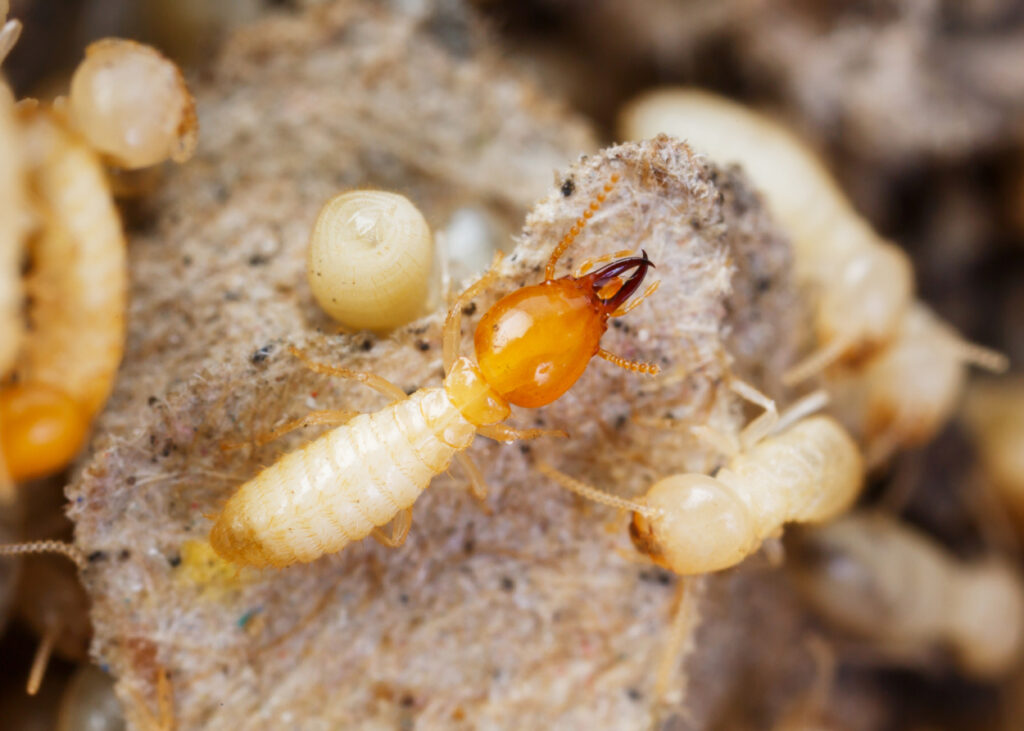
Think of a termite bait station like a Trojan horse. Worker termites — the ones doing all the damage inside your walls — are constantly foraging for food. When they find a bait station, they don’t just eat it themselves. They carry it back to the colony and share it, all the way up to the queen.
The active ingredient in most EPA-approved bait matrices is an insect growth regulator (IGR) — typically hexaflumuron or noviflumuron. These compounds work by disrupting the molting process that termites depend on to survive. Here’s the key: they’re specifically designed to target insect biology. Mammals — including your dog, your cat, and your kids — don’t have the biological pathway these compounds exploit. That’s not marketing language; that’s the science behind why the EPA approves them for residential use around people and pets.
The colony doesn’t collapse overnight. It typically takes 90 days to several months for the bait to work its way through the entire population. But when it works, the whole colony is eliminated — not just the termites you can see.
Why Cape Coral’s Environment Makes Tenting a Harder Sell
Cape Coral isn’t just any Florida city. With over 400 miles of canals — more than any other city in the world — the local water table sits remarkably close to the surface in many neighborhoods. That matters enormously when you’re talking about pest control chemistry.
Traditional whole-structure fumigation uses sulfuryl fluoride gas, which dissipates into the air after treatment and doesn’t leave soil residue. So on that specific point, tenting is actually less of a groundwater concern than older liquid soil barriers were.
But the disruption picture is different. Tenting requires:
- Evacuating your home for 2–3 days (pets included — no exceptions)
- Bagging or removing all food, medications, and anything consumable
- Removing or covering sensitive plants around the structure
- Arranging lodging — a real cost that rarely shows up in the initial quote
For a family with pets, that’s not a minor inconvenience. It’s a logistical operation. And if you’re evaluating the long-term cost of termite damage against your treatment options, that hidden disruption cost matters.
The Side-by-Side: Baiting vs. Tenting
| Factor | Baiting System | Fumigation Tenting |
| Pet Safety | No evacuation required | Full evacuation mandatory |
| Displacement | None | 2–3 days minimum |
| Target Species | Best for subterranean | Effective for drywood & subterranean |
| Speed of Results | 90 days to colony collapse | 24–72 hours |
| Ongoing Monitoring | Quarterly station checks | One-time treatment |
| Landscaping Impact | Minimal | Potential damage from the tent |
| Groundwater Risk | Negligible | Low (gas dissipates) |
| Typical Cost Range | $800–$1,500 install + monitoring | $1,200–$2,500+ (size-dependent) |
“But Do Baiting Systems Actually Work on the Termites Already in My Walls?”
This is the question we hear most often, and it’s the right one to ask.
If you have an active subterranean termite infestation, the worker termites are continuously moving between the soil colony and the wood inside your home. Once bait stations are active and foraging workers find them, the IGR gets distributed through normal colony behavior. The termites in your walls are part of the same colony being fed from the soil — so yes, they’re reached.
The honest caveat: if you have a severe drywood termite infestation (a separate species that lives entirely inside the wood, with no soil contact), baiting alone may not be sufficient. That’s when a targeted, localized treatment or, in some cases, spot fumigation becomes the more appropriate recommendation. A good pest management professional will tell you which species you’re dealing with before recommending a treatment — and if they skip that step, that’s a red flag.
For eliminating subterranean termite colonies, which are by far the most common and destructive species in Southwest Florida, baiting systems have decades of efficacy data behind them.
What Bait Station Installation Actually Looks Like
One thing that surprises most homeowners: the installation is almost anticlimactic. A technician walks the perimeter of your property, installs discreet in-ground stations every 8–10 feet around the foundation, and checks them on a quarterly schedule. You’re home the whole time. Your dog is home. The landscaping stays intact.
During follow-up visits, the technician will show you which stations have active bait hits — physical evidence that termites are feeding. That moment — “showed me the active bait hits” — is when most homeowners go from skeptical to convinced. You can see the system working.
This is also where our strict pet-safe termite prevention protocols matter. Every station placement accounts for accessibility by pets and children, and the bait matrix is housed inside a locked, tamper-resistant casing.
A Word on Long-Term Value
Fumigation is a one-time event with a one-time guarantee window. Once the gas dissipates, your home has no ongoing protection. New colonies can re-establish from neighboring soil within months.
A baiting system, by contrast, is a living perimeter defense. Quarterly monitoring means a technician is regularly checking your property for new activity — and intercepting it before it becomes structural damage. When you’re evaluating the long-term cost of termite damage against treatment options, that ongoing surveillance has real financial value for a home in Cape Coral’s high-humidity, high-termite-pressure environment.
What One Cape Coral Pet Owner Said
“We have two dogs and a tortoise, and I was dreading the whole tenting process. The technician walked the whole yard with me, explained exactly where each station was, and it was done in under two hours. We didn’t change a single thing about our week. Three months later, he showed us the active stations — proof that the system was working. Zero disruption, no chemical smell, and our dogs never even noticed.”
— Cape Coral homeowner, Pine Island Road corridor
Conclusion: The Right Choice for Cape Coral Families
If you have pets, young children, or simply can’t afford three days of hotel stays and logistical chaos, a modern baiting system deserves serious consideration before you default to tenting. For subterranean termites — the dominant threat in Southwest Florida — the efficacy is proven, the safety profile is excellent, and the disruption to your life is essentially zero.
That said, every infestation is different. The most important first step is a proper species identification and inspection by a licensed professional who knows the difference between a subterranean and drywood infestation — and who will give you an honest recommendation rather than a default fumigation quote.
Ready to find out which treatment is right for your home? Schedule a no-obligation inspection with our Cape Coral team. We’ll walk your property with you, identify the species, and give you a clear, honest recommendation — no pressure, no upsell.
Book an Inspection Online
Frequently Asked Questions
How long does it take for a baiting system to achieve full colony collapse compared to tenting?
Fumigation works within 24–72 hours but leaves no residual protection. Baiting systems typically achieve full colony collapse within 90–180 days, depending on colony size and foraging activity. The tradeoff is time vs. ongoing protection — baiting continues to guard your home after the initial colony is eliminated.
What specific active ingredients are in pet-safe termite baits, and why are they safe for mammals?
The most common active ingredients are hexaflumuron and noviflumuron — both insect growth regulators (IGRs) that disrupt the molting process termites require to survive. Mammals don’t have this biological pathway (we don’t molt), which is why these compounds are EPA-approved for use in residential settings with pets and children present.
Why do some companies recommend tenting for drywood termites but baiting for subterranean species?
It comes down to biology. Subterranean termites live in soil colonies and forage above ground — making them ideal candidates for bait interception. Drywood termites live entirely inside the wood with no soil contact, so in-ground bait stations can’t reach them directly. For drywood infestations, localized spot treatments or whole-structure fumigation may be necessary, depending on severity and spread.
