
David Markovits, Owner & Pest Control Specialist: Maximum Pest Control Inc., serving Cape Coral and Lee County for over 30 years.
Quick Summary
- Subterranean termites leave five physical signs before visible structural damage appears: mud tubes, hollow-sounding wood, discarded wings, blistering paint, and sticking doors or windows.
- In Cape Coral’s warm, moisture-rich soil conditions, colonies stay active year-round: making early detection a practical necessity, not a seasonal concern.
- Catching these signs early protects your property investment; the damage that costs homeowners real money isn’t termites themselves: it’s delayed detection.
There are five physical signs that subterranean termites leave behind before structural damage becomes visible, and most Cape Coral homeowners walk past at least one of them for months before connecting the dots.
That’s not a criticism. These signs are subtle, easy to misread as routine wear, and in a Florida home, where humidity and heat do their own work on wood and paint, they blend right in. But in Southwest Florida’s climate, subterranean termite colonies don’t slow down in winter the way they do up north. The window to catch them early is always open, but it just doesn’t stay open forever.
If something around your doors, foundation, or baseboards has been quietly nagging at you, here’s exactly what to look for.
Why Subterranean Termites Are a Particular Concern in Cape Coral
Not all termite species work the same way. Drywood termites infest wood directly; you’ll find them in attic framing or furniture. Subterranean termites come from the ground up, building colonies in the soil and tunneling into your home’s lowest structural points first: sill plates, floor joists, door frames, and slab perimeter framing.
Cape Coral’s soil profile creates near-ideal conditions for this. The sandy loam composition retains moisture well, stays warm year-round, and provides easy tunneling for two of Florida’s most destructive species, Reticulitermes (eastern subterranean termites) and the more aggressive Coptotermes formosanus (Formosan subterranean termites). According to the Florida Department of Agriculture and Consumer Services (FDACS), subterranean termites cause more structural damage than any other termite species in the United States.
In Lee County, there’s no off-season. A colony that establishes itself under your slab in October is just as active in January as it is in July. That’s why knowing the signs and acting on them early is the smartest investment a Cape Coral homeowner can make.
Sign #1: Mud Tubes Along Your Foundation or Slab
What they look like and where to find them
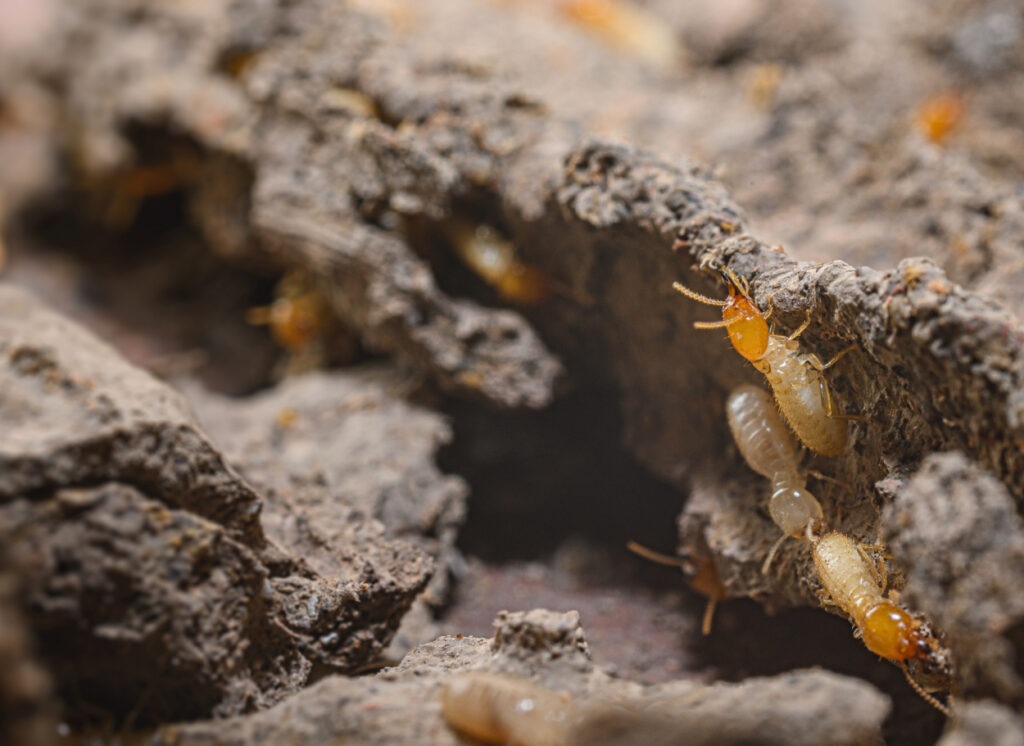
Mud tubes are pencil-width tunnels made of soil, wood particles, and termite saliva. They run along the exterior of your foundation, up concrete block walls, across slab edges, and sometimes up interior drywall near plumbing penetrations. They’re roughly the diameter of a drinking straw, sometimes wider, and have a rough, dried-mud texture.
Check the exterior perimeter of your slab, any visible concrete block near grade level, the interior walls of your garage near the floor, and around the base of any wood framing that contacts or sits close to soil.
To test if a tube is active: Break a small section with your finger. If it’s repaired within a day or two, the colony beneath it is still working. If it stays broken and dries out, the tube may be abandoned, though the colony may have simply moved to a different foraging path.
Of all five signs, mud tubes are the most definitive. If you find one, don’t wait.
Sign #2: Wood That Sounds Hollow When Tapped
Subterranean termites feed from the inside out. They consume the soft interior cellulose of wood while leaving a thin outer shell intact, which is exactly why an infested beam or baseboard can look completely normal from the surface.
Run your knuckle along baseboards, door frames, window sills, and any exposed wood near your slab perimeter. Solid, healthy wood produces a dense thud. Termite-damaged wood sounds hollow, lighter, almost papery. In severe cases, you can press a finger or a screwdriver into it, and the surface gives way entirely.
Common areas in Cape Coral homes: the wood framing around garage door openings, interior door frames (especially in rooms that share a wall with the garage or exterior), and the lower sections of kitchen and bathroom cabinets that sit close to the slab.
Sign #3: Discarded Wings Near Doors, Windows, or Light Fixtures
Once a subterranean termite colony reaches maturity, typically after two to four years of establishment, it produces reproductive swarmers whose job is to leave the colony, mate, and start new ones. In Southwest Florida, the primary swarm season runs from late winter through spring, though Formosan swarmers can fly as late as early summer.
Swarmers are drawn to light. You’ll find their discarded wings, small, translucent, and roughly equal in size, collected near windowsills, door thresholds, light fixtures, and sliding glass doors. They’re easy to mistake for small moth wings or debris. The key identifier: termite swarmer wings come off in matched pairs and have a distinctive two-veined pattern.
Finding discarded wings inside your home is significant. It doesn’t necessarily mean the swarm originated inside, but it does mean a mature colony is active somewhere nearby, possibly already beneath or within your structure. A swarmer event is worth a professional inspection, even if you find nothing else.
Sign #4: Paint That Bubbles, Blisters, or Peels Without an Obvious Water Source
In 30 years of inspecting Cape Coral homes, the sign most homeowners miss first is this one.
Paint bubbling on interior walls, particularly on lower sections near the floor, around door frames, or along baseboards, is almost always attributed to humidity or an old roof leak. In Florida, that assumption makes sense. But when subterranean termites feed through wall framing, they introduce moisture from the soil into the wood. That moisture migrates outward through the drywall and causes paint to bubble, blister, or develop a soft, slightly spongy feel beneath the surface.
The tell: water-damage blistering typically appears near an obvious source (a window, a ceiling, a pipe, or a wall). Termite-related blistering is more localized, often appears near the floor on interior walls, and the paint beneath feels subtly soft rather than brittle and dry. If you can’t trace the blistering to a clear water source, don’t dismiss it.
Sign #5: Doors or Windows That Suddenly Stick
A door that worked perfectly six months ago and now requires a shoulder to open isn’t just a seasonal humidity issue, though that’s a reasonable first assumption in a Florida summer. The difference worth knowing: humidity-caused swelling in wood tends to improve when conditions change. A door that sticks year-round or progressively worsens may be showing you something else.
As subterranean termites feed through the door frame and window frame, the combination of internal moisture and structural weakening can cause frames to shift and warp. This typically appears later in the damage progression; it’s a sign the colony has been active long enough to affect structural geometry, not just surface appearance.
If a sticking door or window is paired with any of the other four signs on this list, treat it as a confirmation, not a coincidence.
If any of these signs look familiar, the fastest way to know for certain is a free inspection from our team, and the most affordable first step you can take toward protecting your home. Schedule your free Cape Coral termite inspection →
What Happens When These Signs Go Unaddressed: A 5-Year Look
The question homeowners ask most often isn’t “what does a mud tube look like”, it’s “how bad can this actually get, and how fast?” Here’s a calm, factual answer based on what we see in Cape Coral homes.
| Timeframe | What’s Happening | Typical Repair Scope |
| Year 1 | Colony establishes in soil beneath or adjacent to the slab; mud tubes begin forming; surface signs appear (occasional wings, first tube formation) | Soil treatment + monitoring; minimal structural impact if caught here |
| Year 2–3 | Active feeding on sill plates, subfloor framing, and lower door/window framing; hollow wood signs become noticeable; paint blistering may appear | Localized framing repair + treatment; moderate cost |
| Year 4–5 | Feeding reaches load-bearing elements; structural compromise is possible in floor joists, interior wall framing, and sticking doors and windows become consistent | Significant structural repair; can run $10,000–$30,000+ depending on scope |
The framing matters: a Cape Coral home caught at Year 1 requires a treatment and a monitor. A home caught at Year 4 requires a contractor and a treatment. The termites aren’t the expensive part; the delay is.
To ensure your home stays structurally sound, the goal is to intercept this timeline as early as possible, ideally before it reaches Year 2.
Why Annual Termite Inspections Are a Smart Investment in Lee County
A trained technician inspecting your foundation, slab perimeter, crawl spaces, and interior framing will find early-stage mud tubes, hollow wood sections, and soil conditions that no DIY check reliably catches. The variables are simply too small and too numerous for an untrained eye to process quickly.
For Cape Coral homeowners, an annual professional inspection is practical property maintenance, the same category as servicing your HVAC or checking your roof after storm season. In a climate where subterranean termites are active 12 months a year, waiting until you’re certain something is wrong means you’ve already lost ground.
Every inspection with Maximum Pest Control includes a thorough walkthrough of your property, foundation, garage framing, slab entry points, and interior perimeter, with a clear, honest assessment of what we find. If treatment is needed, we build a customized plan tailored to your home’s construction, landscaping, and your family’s needs, including eco-friendly options using EPA-approved products that are safe for families and pets when applied by a licensed technician. If nothing is found, you have documented confirmation of a clean inspection, which has real value for your own peace of mind and your home’s resale record.
Our team’s 30 years of Southwest Florida experience means we know the soil conditions, the seasonal patterns, and the construction styles of Lee County homes in a way that national franchise brands simply don’t. That local knowledge is the difference between a rushed walkthrough and an inspection that actually catches what’s there.
Ready to Protect Your Property Investment?
Knowing the five signs puts you ahead of most Cape Coral homeowners. The next step is making sure none of them are present in your home right now.
Schedule your free termite inspection with Maximum Pest Control. We’ll assess your property thoroughly, answer your questions directly, and give you a clear picture of where you stand, no pressure, no surprises.
📞 Call us today or book your free inspection online →
Maximum Pest Control Inc., protecting Cape Coral and Lee County homes for over 30 years.
Frequently Asked Questions
How do I know if I have subterranean termites without seeing them?
The most reliable method is checking your foundation perimeter and interior baseboards for mud tubes, pencil-thin tunnels of dried soil that the colony builds to travel from the ground into your home. You can also tap wood surfaces near the floor; hollow-sounding wood is a strong indicator of internal feeding. Discarded wings near doors or windows after a swarm event are another sign a mature colony is active nearby. A professional inspection will confirm what a visual check can only suggest.
How quickly can subterranean termites damage a Florida home?
In Cape Coral’s year-round warm climate, a colony that establishes in Year 1 can reach sill plates and subfloor framing by Year 2–3, and begin affecting load-bearing elements by Year 4–5 if untreated. The pace depends on colony size, species (Formosan colonies are significantly more aggressive than eastern subterranean species), and how much accessible wood framing is near the soil grade. The critical point: structural repair costs escalate sharply after Year 3. Early detection makes the difference between a soil treatment and a contractor.
How often should Cape Coral homeowners schedule a professional termite inspection?
Annually. Unlike northern states, where subterranean termite activity slows in cold months, Cape Coral’s climate supports year-round colony activity. An annual inspection gives you a current baseline, catches new activity before it progresses, and provides documented inspection records, which carry value when it comes time to sell. Free inspections are available through Maximum Pest Control for both residential and commercial properties in Lee County.
 Pet-Safe Lawn Pest Control in Cape Coral: What Dog Owners Need to Know Before They Spray